
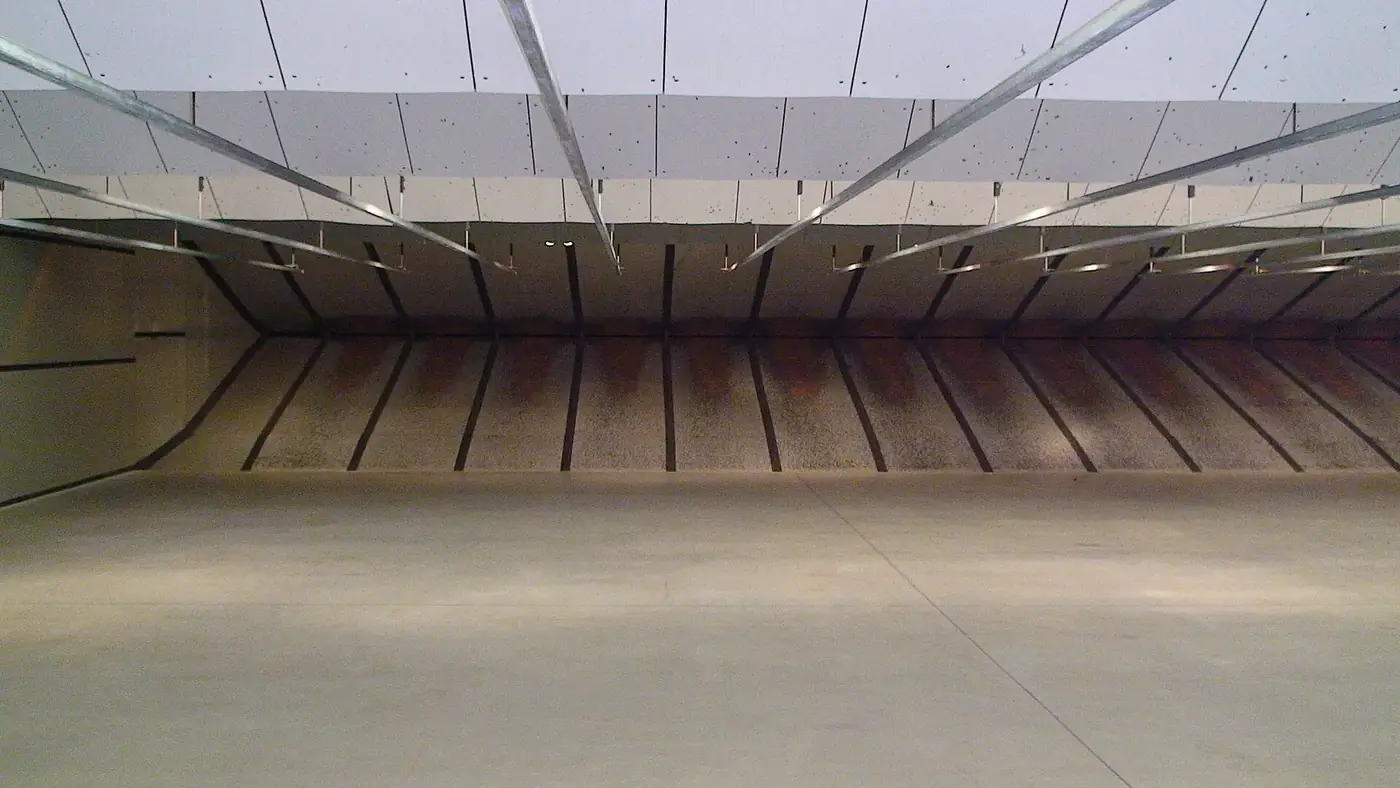
Choose an indoor range if you mainly shoot handguns at short distances, want a staffed, climate-controlled place you can visit year round, or need rentals and lessons. Choose an outdoor range if you shoot rifles beyond 25 yards, want to shoot shotguns at clay targets, need more freedom in how you set up targets, or want lower-cost or free access through public land and state agency ranges. Many shooters use both: indoors for regular handgun practice, outdoors for rifle work and sighting in.
Of the 3,300 shooting ranges in our directory, 2,535 are outdoor and 476 are indoor, so depending on where you live, one type may be much easier to reach than the other.
Key points
- Indoor ranges suit short-distance handgun practice, beginners, rentals and lessons, in any weather.
- Outdoor ranges suit rifle work past 25 yards, sighting in, clay sports and steel targets.
- Outdoor public ranges run by state agencies are often the lowest-cost option; some are free.
- Many shooters use both: indoors for regular handgun practice, outdoors for rifle work.
The quick comparison
| Indoor ranges | Outdoor ranges | |
|---|---|---|
| Typical distances | Often 25 yards or less for pistol lanes; some offer longer rifle lanes | 25 to 100 yards common; some go to several hundred yards or more |
| Firearms | Handguns, and rifles in calibers the backstop is rated for | Handguns, rifles, shotguns (on dedicated fields) |
| Weather | Not a factor | Heat, cold, wind, rain and daylight all matter |
| Noise | Concussion and echo are stronger in an enclosed space | Sound dissipates more, but rifles are still loud |
| Staffing | Usually staffed during open hours | Ranges from fully staffed to unattended |
| Rentals and lessons | Common | Less common, varies widely |
| Access | Usually lane fees or membership | Fees, memberships, state permits or free |
| Targets | Paper on motorized carriers; steel rarely allowed | Paper, steel and reactive targets, depending on range rules |
Indoor ranges: what they do well
Convenience and consistency
Indoor ranges are typically in or near towns, open long hours, and unaffected by weather or daylight. That makes them easy to fit into a weeknight. Lighting is consistent, there is no wind, and target carriers bring your paper target to you, so you never walk downrange.
Built for beginners
Commercial indoor ranges are often attached to a gun shop and are set up for people who have never shot before. Most rent firearms and protective gear, run safety briefings, and have ROs watching the line. If you are new, an indoor range with rentals or lessons is a low-pressure start. Our first-time guide walks through what to expect.
Handgun practice
Most defensive handgun shooting happens at short distances, which fits the typical indoor lane well. For regular practice on fundamentals (grip, sight alignment, trigger control), an indoor range covers most of what you need.
Indoor drawbacks
- Noise and concussion. Gunfire indoors is louder and more jarring, especially from a short-barreled rifle or a compensated pistol in the next lane. Doubling up with foam ear plugs under electronic earmuffs is common practice indoors. Our hearing protection guide explains NRR and how doubling works.
- Lead exposure. Indoor ranges rely on ventilation to move lead dust and combustion products away from shooters. Wash your hands and face before eating, and consider lead removal soap or wipes. Change clothes after a session if you shoot often.
- Restrictions. Indoor ranges commonly limit calibers, ban steel-core and some other ammunition types, restrict rapid fire and holster draws, and may require you to buy ammunition on site.
- Distance. Lanes are often short. You cannot properly zero most hunting rifles at 25 yards and confirm them at 100.
- Shotguns and clays are not an option indoors (some ranges allow slugs on paper; ask first).
Outdoor ranges: what they do well
Distance and rifle work
If you shoot rifles, outdoor is where you will spend most of your time. A 100-yard bench is the standard place to sight in a hunting rifle, and dedicated long range facilities (93 in our directory) let you practice at much greater distances. See our guide to sighting in a rifle before hunting season.
Shotgun sports
Trap, skeet and sporting clays all happen outdoors. We list 526 ranges with trap, 358 with skeet and 237 with sporting clays. If those terms are new to you, read trap, skeet and sporting clays explained.
Variety of targets
Outdoor ranges are more likely to allow steel targets, reactive targets and target stands you set up yourself. Some have action bays for practical shooting. Rules on what you can shoot at still vary by range, so check before you bring your own steel. Our targets guide covers the options.
Lower-cost and free access
State wildlife and natural resources agencies operate many outdoor ranges, often funded in part by the federal Pittman-Robertson excise tax on firearms and ammunition. Some are free; some require a state permit, license or day fee. We list 764 public ranges and 51 listed as free. Browse public ranges and free ranges, or read our guide to finding free and public ranges.
Outdoor drawbacks
- Weather and daylight. Heat, cold, wind and rain all affect comfort and accuracy. Most outdoor ranges close at dusk.
- Less supervision. Some outdoor ranges, especially public ones in remote areas, have no staff on site. You are responsible for following the rules and calling cease fires. Read our post on range rules and commands before visiting an unstaffed range.
- Distance from town. Outdoor ranges need space, so they tend to be a drive away.
- Fewer rentals. Plan to bring your own firearms and gear.
Tip: At an unstaffed outdoor range, you are the range officer. Agree on cease fire procedures with everyone on the line before anyone shoots.
Which to choose, by goal
| Goal | Better fit |
|---|---|
| First time shooting | Indoor, staffed, with rentals |
| Handgun practice | Indoor, or outdoor for draw and movement |
| Sighting in a hunting rifle | Outdoor, 100-yard bench |
| Long range precision | Outdoor long range facility |
| Clay targets | Outdoor trap, skeet or sporting clays |
| Shooting on a budget | Outdoor public or state agency range |
In more detail:
- First time shooting: Indoor, staffed, with rentals or a beginner class.
- Handgun practice: Indoor for convenience; outdoor if you want to practice drawing or moving (where allowed).
- Sighting in a hunting rifle: Outdoor, with a 100-yard bench at minimum.
- Long range precision: Outdoor long range facility.
- Clay targets: Outdoor trap, skeet or sporting clays field.
- Archery: Many outdoor ranges and some indoor facilities have archery lanes. We list 773 ranges with archery; see our archery ranges guide.
- Shooting on a budget: Outdoor public ranges run by state agencies, or established public land areas where target shooting is allowed.
Gear differences
The core gear is the same for both: impact-rated eye protection and hearing protection. Beyond that:
Indoor extras: doubled hearing protection, a brimmed cap against ejected brass, and something to clean your hands afterward.
Outdoor extras: a shooting rest or sandbags for bench work, a spotting scope or binoculars to see hits at distance, a portable target stand if the range does not provide frames, sunscreen, water and weather layers. Our range bag checklist has a complete list for both.
Cost structure
Indoor ranges usually charge per lane by the hour or per session, with extra fees for rentals and targets, and offer memberships for regulars. Outdoor ranges range from paid private clubs with annual dues to state-run ranges that are free or require a permit. Our post on what a shooting range costs breaks down the fee types.
Wrap-up
Indoor ranges win on convenience, staffing and beginner support. Outdoor ranges win on distance, variety and low-cost public access. Most people end up using both. To see what is near you, browse indoor ranges near you, our full list of outdoor ranges, or ranges by state. If a range near you is missing, add it to the directory.