
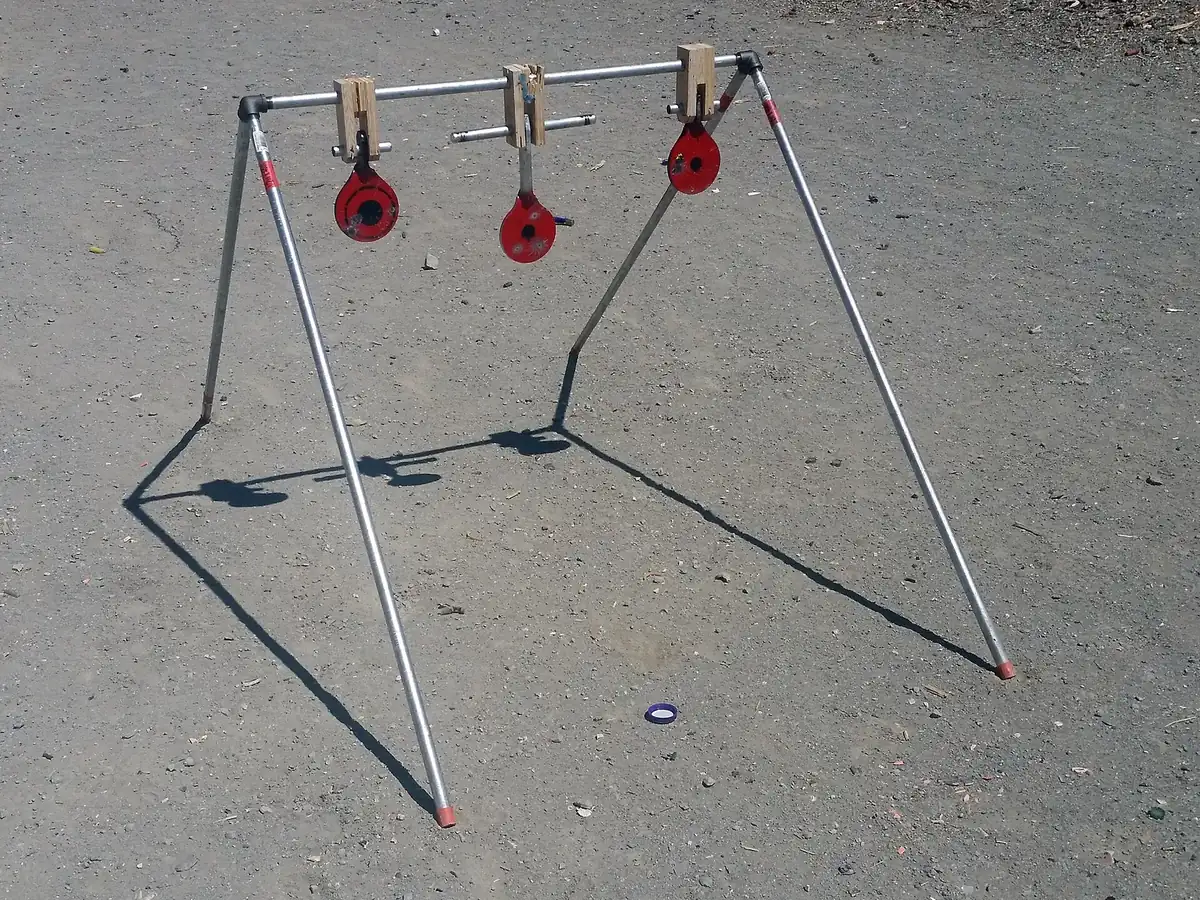
Paper targets are the best tool for measuring accuracy and are allowed almost everywhere. Steel targets give instant feedback with a ring you can hear, but they are only safe when made of hardened steel such as AR500, set at an angle, kept in good condition, and shot from at least the minimum distance set by the target maker and the range. Reactive targets (adhesive splatter targets, self-healing rubber and spinners) fall in between. Before you buy anything, check what your range allows, because target rules vary more than most other range rules.
Key points
- Paper targets are the best tool for measuring accuracy and are allowed almost everywhere.
- Steel is only safe when it is hardened (such as AR500), angled down, in good condition and shot from at least the minimum distance.
- Reactive targets like splatter, self-healing and spinner targets give feedback without most of the hazards of steel.
- Target rules vary a lot by range, so check what is allowed before you buy or set up.
Start with your range's rules
Ranges restrict targets for good reasons: steel can send fragments back toward the line, some targets damage berms or frames, and loose debris is hard to clean up. Common restrictions include:
- Paper only, especially at indoor ranges, where the backstop and lane carriers are built for paper.
- No steel, or steel only in designated bays at set distances.
- No targets on the ground or on the berm face.
- No glass, bottles, cans, appliances or other trash. These are banned at most ranges and on public land.
- No exploding targets. Binary exploding targets are prohibited at most ranges and on many public lands, and they have started wildfires. Check with the land manager before even considering them.
- Restrictions on target types, such as silhouettes, at some ranges.
Read the posted rules or call ahead. If you shoot on public land, see our guides to shooting on BLM land and shooting in national forests, and check the managing agency's current rules for that area.
Paper and cardboard targets
Paper is cheap, quiet, and tells you exactly where every shot went. It is the right choice for sighting in, zeroing optics, grouping, and tracking progress over time.
Common paper target types
- Bullseye targets with scoring rings, for precision practice and formal competition.
- Sight-in and grid targets with 1-inch squares or diamonds, which make it easy to measure group size and calculate scope adjustments. Useful when sighting in a rifle before hunting season.
- Silhouette and practical targets with scoring zones, used for defensive and action pistol practice where the range allows them.
- Dot drills, sheets of small circles used for specific drills, popular for pistol fundamentals.
- Adhesive splatter targets, which show a bright ring around each hole so you can see hits from the line without a spotting scope.
Setting up paper
Staple or clip paper to a cardboard backer on a stand, rather than taping it to a frame that might take a hit. Hang it so the aiming point is at a height that keeps your shots going into the berm. Bring target pasters to cover holes so you can reuse a target, and a staple gun if the range does not provide one.
Steel targets
Steel is popular because it is fun and fast: you hear and see the hit immediately, which is useful for timed drills and longer distances where holes in paper are hard to see. We list 73 ranges that allow steel targets. Steel is also the target type most likely to injure someone if it is used wrong, so it is worth understanding the rules.
Use hardened steel made for shooting
Shooting targets should be made from hardened, abrasion-resistant steel, commonly AR500 or harder. Hardened steel makes bullets break up and splash on the surface. Mild steel (like scrap plate or a homemade target from hardware store stock) dents and craters. Craters and dimples are dangerous because they can redirect fragments back toward the shooter at unpredictable angles.
Buy targets from makers who state the steel grade and thickness and publish rated calibers, velocities and minimum distances. Thickness and hardness determine what a target can handle; a plate rated for pistols may be damaged by rifle rounds.
Follow the minimum distance rules
Fragments from bullets hitting steel can travel back a surprising distance. Steel target manufacturers publish minimum distances, typically with separate, much greater distances for rifles than for handguns, and ranges often set their own minimums for steel bays. There is no single universal number. Use whichever is greater: the target maker's minimum for your firearm and ammunition, or the range's posted rule.
Safety: Rifle steel needs rifle distances and a plate rated for rifle rounds. A plate rated for pistols can crater or fail under rifle fire.
Two rules apply everywhere:
- Never shoot steel with rifle rounds at pistol distances. Rifle bullets hit with far more velocity and energy, and they can crater or punch through plates that are fine for handguns. Rifle steel needs rifle distances and a target rated for it.
- Never shoot steel with steel-core, armor-piercing or penetrator ammunition. These rounds damage plates and increase the risk of ricochet. Many ranges ban them outright, and some ban them range-wide, not just on steel. Check your ammunition's description if you are unsure what it contains.
Angle and placement
- Angle the face downward, toward the ground in front of the target. Most quality stands are built to hold the plate tilted forward, so fragments are directed down into the dirt rather than back at the line.
- Hang plates so they can swing, on chains or straps, or use stands designed to move with the hit. Rigidly fixed plates deflect more energy back.
- Shoot steel square-on. Do not shoot a plate from a sharp angle off to the side, which can send fragments sideways toward other shooters.
- Put a proper backstop behind it. A berm should catch misses and anything that passes the plate.
- Keep other people behind the line, and keep the area around the target clear.
Inspect before every session
Look over every plate before you shoot. Retire any steel that has craters, deep pits, holes, cracks or bent edges. Check chains, hooks and stands too, since a target that falls or hangs crooked changes the angle. Many shooters paint plates between strings with target marking paint so new hits are easy to see.
Eye protection is not optional around steel. Small fragments are common even when everything is done correctly. Our shooting glasses guide explains the ANSI Z87.1 impact rating to look for.
Reactive targets
Reactive targets give feedback without the hazards of steel.
- Adhesive splatter targets show a colored ring around each hit. They go on paper or cardboard and work anywhere paper is allowed.
- Self-healing targets made of polymer or rubber let bullets pass through and close up behind them. They bounce or roll when hit and last many sessions. Check the maker's rated calibers.
- Spinners and dueling trees flip when hit. Steel versions follow every steel rule above.
- Clay targets on a berm, where the range allows it, break visibly. Pick up the pieces afterward.
Target stands
A stable stand makes everything easier, especially at ranges without built-in frames. Look for one that folds flat for transport, holds a cardboard backer at a useful height, and stays put in wind. Ground stakes or sandbag weights help on windy days. Do not shoot near the stand's uprights. Wooden furring strips are a common choice for uprights because they are cheap to replace when hit.
Matching targets to the kind of shooting
| Goal | Good target choice |
|---|---|
| Zeroing a rifle or optic | Grid sight-in targets on paper |
| Pistol fundamentals | Dot drills, bullseyes |
| Defensive practice | Practical or silhouette paper, where allowed |
| Fast feedback at distance | Steel rated for your caliber, at the maker's and range's minimum distance |
| Fun with new shooters | Adhesive splatter targets, self-healing targets |
Pistol ranges and rifle ranges often set different target rules for each bay, so ask which bay fits what you want to do.
Gear for this
- Paper targets in a few styles
- Grid sight-in targets for zeroing
- Adhesive splatter targets
- A portable target stand
- AR500 steel targets with published caliber and distance ratings
- Self-healing targets
Add them to your range bag along with tape, staples and a marker.
Wrap-up
Use paper to measure, steel to train fast feedback (only hardened, inspected, angled and at the proper distance), and reactive targets to keep things interesting. Whatever you hang, follow the four safety rules: treat every firearm as loaded, keep the muzzle in a safe direction, keep your finger off the trigger until you are ready to shoot, and know your target and what is beyond it. To find a place to shoot, browse ranges with steel targets, outdoor ranges or ranges near you, and add a listing if your range is missing.