
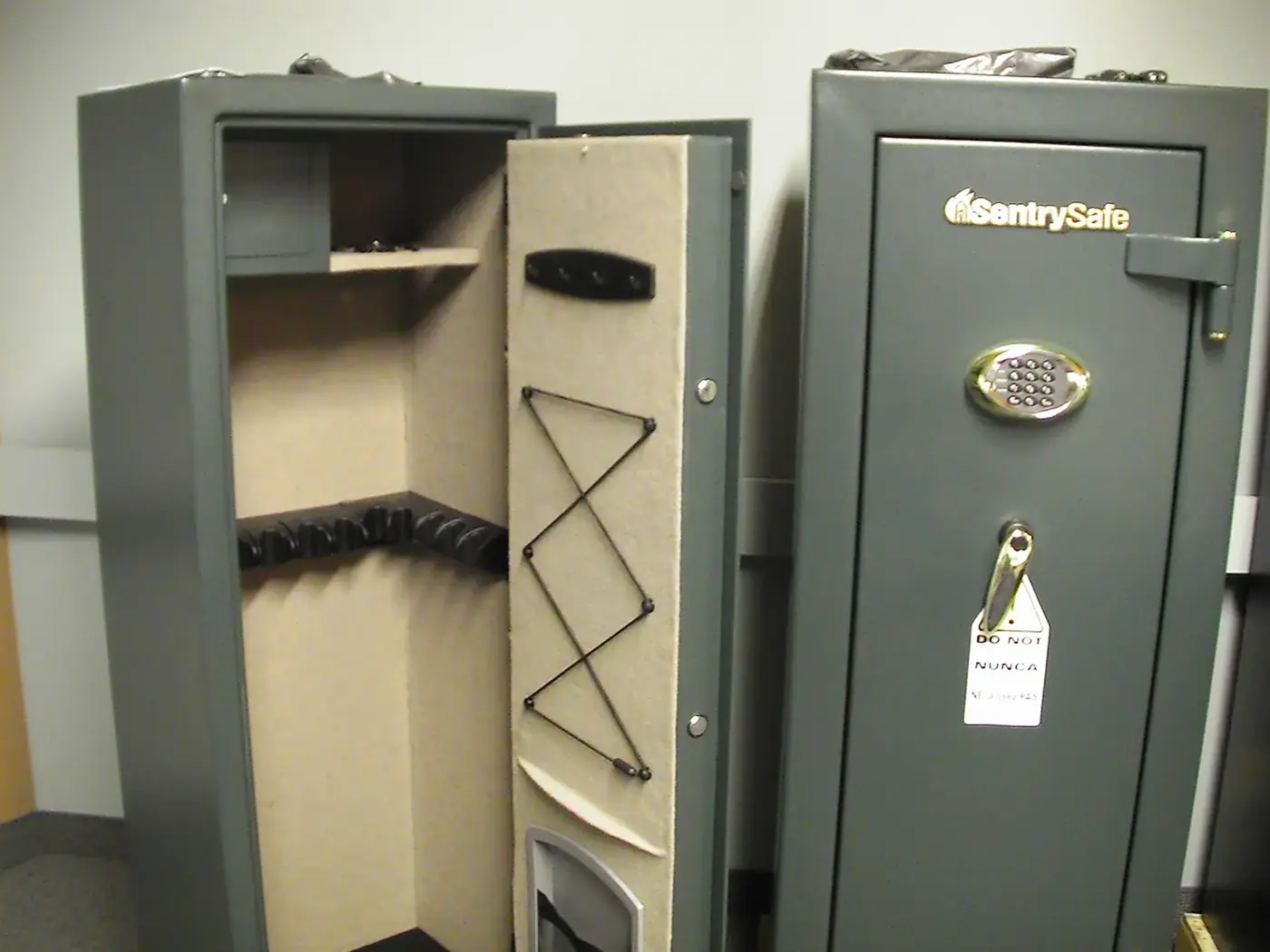
Safe storage at home means keeping firearms locked and out of reach of anyone who should not have them, especially children and visitors, and ideally storing ammunition separately. The right tool depends on how many firearms you own, who lives in or visits your home, and whether you need quick access to one of them. Options range from a cable lock on a single gun to a lockbox, a steel cabinet or a full safe. Storage laws, including child access prevention laws, vary by state and sometimes by city, so check your state's rules (your state attorney general or state police website is a good starting point) and treat this guide as general background, not legal advice.
Key points
- Match storage to the risk: unauthorized access, theft, fire, or the need for quick access.
- A lock or lockbox keeps curious hands out; a certified safe slows a thief.
- Look for a verifiable UL RSC label and an independently tested fire rating, not appearance.
- Buy bigger than you think, bolt the safe down, control the keys and codes, and add humidity control.
Start with what you need to protect against
Different storage solves different problems. Before you shop, decide which of these matter most to you:
- Unauthorized access in the home. Children, teenagers, guests, roommates or anyone at risk of self-harm. This is the core purpose of safe storage, and almost any locked option helps.
- Theft. A burglar with a few minutes and some tools. This calls for heavier steel, a good lock and bolting the container down.
- Fire. Protection for firearms and documents during a house fire. This calls for a fire-rated safe.
- Quick access. If you keep a firearm for home defense, you need storage that opens fast for you and stays shut for everyone else.
Many households end up with one large safe plus a small quick-access box.
Types of storage
The main options at a glance:
| Storage type | Main strength | Limits |
|---|---|---|
| Cable or trigger lock | Blocks loading or firing a single gun | Does not stop theft of the locked gun |
| Lockbox or quick-access pistol safe | Fast access to one or two handguns | Small capacity; bolt or tether it down |
| Gun cabinet | Keeps long guns from children and casual access | Not built to resist tools; most offer no fire protection |
| Gun safe | Heavier steel, multiple bolts, often fire-resistant | Heavy; real security varies, so check the labels |
Cable locks and trigger locks
A cable lock runs through the action or magazine well and blocks the firearm from being loaded or fired. Many new firearms ship with one, and some local agencies hand them out. They are inexpensive and better than nothing, but they do not stop theft: someone can carry off the locked gun. Trigger locks clamp around the trigger guard and should only ever be fitted to an unloaded firearm.
Lockboxes and quick-access pistol safes
Small steel boxes sized for one or two handguns. Many open with a keypad, a mechanical push-button lock or a fingerprint reader, and some have a cable to tether the box to a bed frame or a car seat. A quick-access pistol safe suits a bedside or closet shelf. Look for:
- Steel thickness and solid hinges, not just a strong-looking lock.
- Pre-drilled holes so you can bolt it to a shelf or floor.
- A backup key or override, and a plan for where you keep that key.
- A battery-low warning on electronic models.
Gun cabinets
Thin-walled steel cabinets with a key or simple lock. They keep long guns away from children and casual access at a lower cost and weight than a safe. They are not designed to resist a determined thief with tools, and most offer no fire protection. A steel gun cabinet can be a reasonable first step for a small collection.
Gun safes
Heavier steel bodies, thicker doors, multiple locking bolts, and often a fire-resistant lining. Real security varies widely, so judge gun safes on the labels and construction below, not appearance.
What the ratings mean
UL RSC (Residential Security Container)
A UL RSC label means the safe was tested by UL to a standard for residential security containers, which involves a short attack by a tester using common hand tools. It is a meaningful baseline: the container held up to that test. It does not mean the safe will resist a longer attack or power tools. Higher UL burglary ratings exist (such as TL-15 and TL-30 for commercial safes), and they reflect much more demanding tests, with much heavier and costlier safes to match.
Some safes only claim to "meet" a standard. Look for a UL listing you can verify.
Fire ratings
Fire ratings are usually stated as a length of time at a given outside temperature. In plain terms, the claim is that the inside of the safe stays below a damaging temperature for that long while the outside is heated. When comparing:
- Who tested it matters. Independent testing by a lab (such as UL or Intertek) is more reliable than a manufacturer's in-house test. Check whether the rating is certified by a lab or just claimed.
- Fire protection is not theft protection. Many fire-rated safes use gypsum board linings between thin steel sheets. They can resist heat well and still be easy to pry open.
- Contents matter. Paper, firearms and digital media tolerate different temperatures. Electronic media like USB drives and discs are more sensitive to heat than paper, so if you store them, look for a safe or insert specifically rated for media.
- Door seals. Many fire safes have a seal that expands with heat to block smoke and hot gases. Some also claim water resistance, which can help when firefighters spray the house.
Lock types
| Lock | Strengths | Watch for |
|---|---|---|
| Mechanical dial | Very durable, no batteries | Slow to open |
| Electronic keypad | Faster, easy code changes | Battery replacement, variable quality |
| Biometric | Fastest for one or two users | Reliability; needs a backup entry method |
| Keyed | Simple | The key becomes the weak point |
- Mechanical dial. Slow to open but very durable and needs no batteries.
- Electronic keypad. Faster to open and easy to change the code. Batteries need replacing, and quality varies. Many have a backup key.
- Biometric (fingerprint). The fastest for one or two users when it reads reliably. Read reviews carefully on reliability, and make sure there is a backup method of entry. A biometric safe works best when enrolled with several fingers.
- Keyed. Simple, but the key becomes the weak point. Keep it somewhere children cannot find it.
Whatever lock you choose, never write the code on or near the safe, and change the default code on electronic locks right away.
Size, weight and placement
- Buy bigger than you think. Advertised gun capacity usually assumes slim long guns packed tight with no optics. Scoped rifles, cases and other valuables take far more room.
- Check the delivery path. Measure doorways, stairs and turns. A full-size safe can weigh several hundred pounds or more, so confirm the floor can take the weight, especially upstairs.
- Bolt it down. Most safes come with anchor holes. An unbolted safe can be tipped over or carried off. Bolting into a concrete floor is ideal.
- Location. A closet, basement or garage corner out of sight is common. Basements can flood and garages can get humid and hot, so weigh those risks.
Humidity and rust
A closed steel box traps moisture, which can cause rust on firearms stored for long periods. Two common fixes:
- A dehumidifier rod, which uses gentle heat to keep the air inside a little warmer and drier. It needs a power outlet and usually a cord pass-through in the safe.
- rechargeable desiccant canisters, which absorb moisture and can be dried out in an oven when they change color.
Clean and lightly oil firearms before long storage (see our gun cleaning basics) and avoid storing them in foam cases, which can hold moisture against metal.
Good storage habits
- Store firearms unloaded unless one is kept for home defense in a quick-access safe, and store ammunition separately where practical.
- Control the keys and codes. Storage only works if the people you are protecting against cannot get in.
- Talk to children about what to do if they ever find a firearm: do not touch it, leave the area and tell an adult.
- Use a cased, locked routine when traveling. Our guide to gun cases and transport covers getting firearms to and from the range.
- Keep records. Note serial numbers, make and model, and photographs, and keep a copy somewhere other than the safe.
- Follow the basic safety rules every time you handle a firearm: treat it as loaded, keep the muzzle in a safe direction, keep your finger off the trigger until ready to fire, and know your target and what is beyond it.
Quick buying checklist
- Decide what you are protecting against: access, theft, fire, or all three.
- Count your firearms, then size up.
- Look for a verifiable UL RSC label or higher for theft resistance.
- Look for an independently tested fire rating if fire protection matters.
- Choose a lock that suits how fast you need access and who uses it.
- Plan placement, delivery and anchoring before it arrives.
- Add humidity control.
Gear for this
Wrap-up
Good home storage is mostly about matching the container to the risk: a lock or lockbox to keep curious hands out, a certified safe to slow down a thief, and a fire rating if you want contents to survive a house fire. Check your state's storage rules, bolt the safe down and control the keys. Many gun shops sell and deliver safes, and many firearms academies and ranges offering lessons teach safe handling and storage as part of their basic courses. To find one near you, start at ranges near you.