
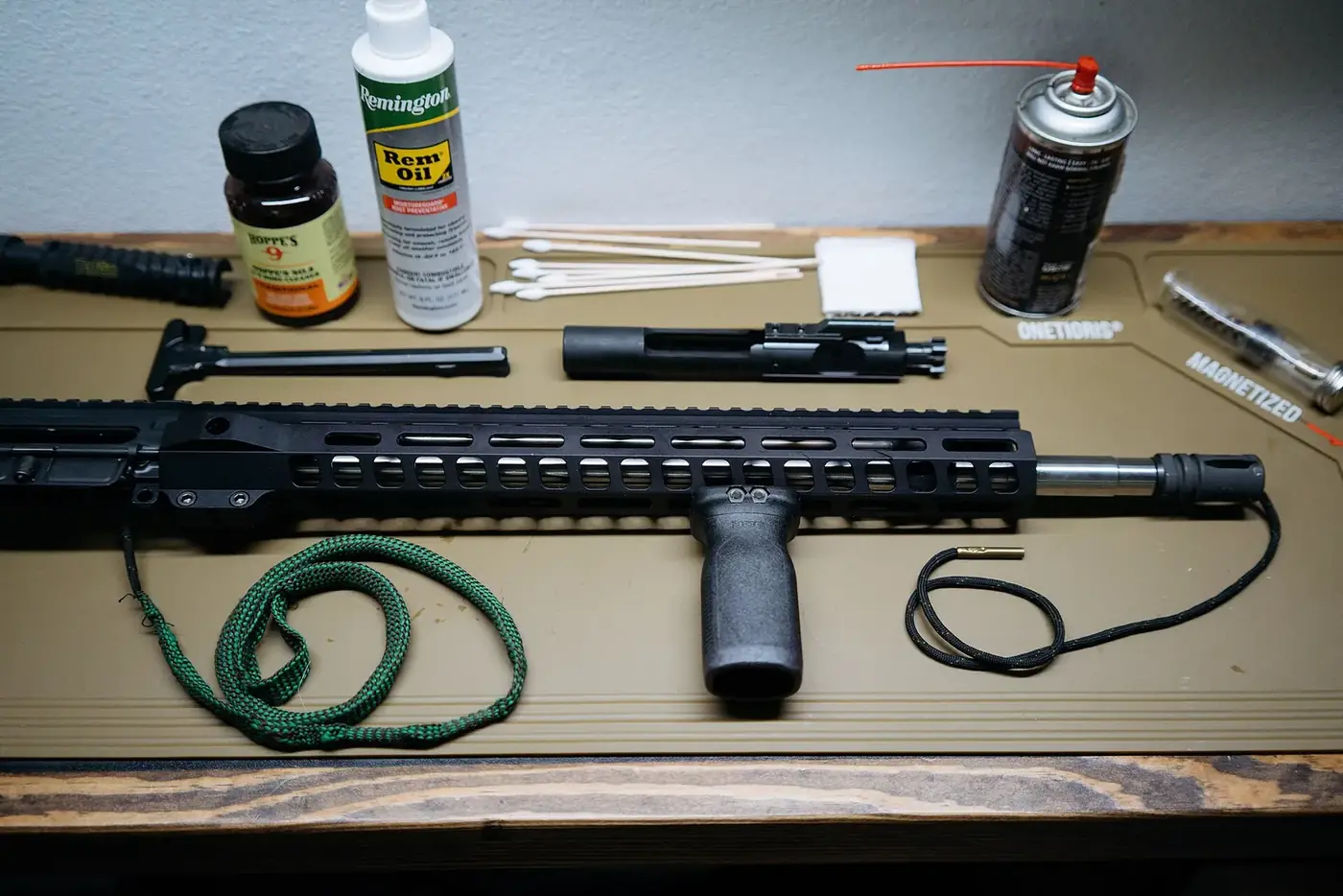
A basic gun cleaning kit needs a cleaning rod or pull-through, caliber-specific brushes, jags and patches, a solvent, a lubricant, a nylon utility brush and some clean cloths. Most shooters clean after range sessions or every so often depending on how much they shoot, but the right schedule depends on your firearm, your ammunition, the conditions you shoot in and your manufacturer's guidance. Clean immediately after shooting corrosive ammunition or getting your firearm wet. Here is what goes in a kit and how to use it safely.
Key points
- A basic kit covers a rod or pull-through, caliber-specific brushes, jags and patches, solvent, lubricant, a nylon brush and cloths.
- Before cleaning, unload, check the chamber, and remove all ammunition from the room.
- Follow your owner's manual for field stripping and where lubricant goes; more oil is not better.
- Clean the same day after corrosive ammunition or getting your firearm wet.
Safety before you start
Cleaning is a common time for negligent discharges, because people assume the firearm is already unloaded. Before you start:
- Unload the firearm following the owner's manual. Remove the magazine first, then clear the chamber.
- Visually and physically check the chamber and magazine well (or every chamber of a revolver cylinder).
- Remove all ammunition from the room or work area. This one step prevents a lot of accidents.
- Still treat it as loaded. Keep the muzzle in a safe direction and your finger off the trigger, even while cleaning.
Also:
- Ventilate. Solvents give off fumes. Work in a well-ventilated area.
- Protect your eyes. Springs can launch small parts and solvent can splash. Your shooting glasses work fine for this.
- Wear gloves. Nitrile gloves keep solvent and residue off your skin. Fired-gun residue can contain lead.
- Wash your hands with soap and cold water when you are done, and do not eat or drink while cleaning.
- Keep kids and pets away, and store solvents where children cannot reach them.
What goes in a cleaning kit
Bore cleaning tools
- Cleaning rod. A one-piece coated steel or carbon fiber rod is gentler on the bore than jointed rods, whose joints can rub the rifling. Get one long enough for your longest barrel.
- Bore guide for rifles cleaned from the breech. It centers the rod and keeps solvent out of the action.
- Pull-through cleaner. A rope-style bore cleaner such as the Hoppe's BoreSnake is quick and compact, good for the range bag or a field cleaning between full cleanings.
- Bore brushes sized for each caliber or gauge. Bronze brushes are standard for removing fouling; nylon brushes are gentler.
- Jags and slotted tips that hold patches. A jag pushes a patch snugly through the bore; a slotted tip holds a patch through a slot.
- Patches sized to the caliber. Too big and they jam; too small and they do not clean.
Chemicals
- Solvent to break down carbon and powder fouling. Some solvents are also formulated for copper fouling in rifle bores. Hoppe's No. 9 is a long-standing, widely sold example.
- Lubricant (oil or grease) to reduce friction and wear on moving parts. Follow the manual for where grease or oil belongs.
- CLP (cleaner, lubricant, protectant) products combine the three in one bottle. They are convenient for routine cleaning, though dedicated solvents usually work faster on heavy fouling.
- Rust preventive for long-term storage, especially in humid climates.
Everything else
- Nylon utility brush (an old toothbrush works) for slides, bolts and actions.
- Cotton swabs and picks for corners and tight spots. Use plastic or brass picks rather than steel to avoid scratching finishes.
- Microfiber cloths or rags for wiping down exterior surfaces.
- A cleaning mat that resists solvent and keeps small parts from rolling away.
- A small flashlight or bore light to inspect the bore.
- Nitrile gloves.
A caliber-specific kit is fine if you own one firearm. If you own several, a universal kit with adapters for different calibers, plus extra patches and brushes for the ones you shoot most, usually makes more sense.
A basic cleaning routine
Always follow your owner's manual first. It tells you how to field strip your specific firearm and where lubricant should and should not go. The general routine:
- Unload, verify and clear the area as described above.
- Field strip to the level the manual describes. You do not need to detail strip for routine cleaning.
- Apply solvent to the bore. Run a wet patch through and let the solvent sit for a few minutes per the product label.
- Brush the bore. Run a brush through a few times, ideally from the breech toward the muzzle when the design allows. Pushing from the muzzle end risks damaging the crown, which affects accuracy.
- Push dry patches through until they come out mostly clean. Do not expect perfectly white patches in every bore.
- Clean the action, slide, bolt and other parts with solvent and the utility brush. Focus on areas with heavy carbon, like the breech face, feed ramp and bolt face.
- Wipe everything dry. Leftover solvent can attract grime or soften some finishes.
- Lubricate lightly at the points the manual specifies. More oil is not better; excess oil collects dirt and can get into places it should not, like a firing pin channel.
- Run a lightly oiled patch through the bore if the firearm is going into storage, and then a dry patch before shooting again.
- Reassemble and function check following the manual.
- Wipe down the exterior with a lightly oiled cloth to remove fingerprints, which can cause rust on blued steel.
Shotguns follow the same pattern with larger tools. Clean the choke tubes and their threads too, and do not shoot without a choke installed if your barrel is threaded for them.
How often to clean
There is no single rule. Here is a quick summary, with more detail below:
| Situation | When to clean |
|---|---|
| Corrosive ammunition | The same day, with a cleaner made to remove the salts |
| Wet, muddy or dusty conditions | Soon after, and dry it thoroughly |
| Regular range use | After each trip or after a set number of rounds |
| Home defense or daily carry | Inspect and clean on a regular schedule |
| Before long storage | Clean and lightly protect it, then recheck occasionally |
Factors that matter:
- Manufacturer's guidance. Your owner's manual is the best reference for your firearm.
- How much you shoot. Some shooters clean after every range trip; others clean after a set number of rounds. Either way, a firearm that is shot a lot needs regular attention.
- Ammunition type. Rimfire and some cheaper ammunition foul actions faster. Lead bullets can leave lead fouling in the bore.
- Corrosive ammunition. Some military surplus ammunition uses corrosive primers, which leave salts that attract moisture and cause rust. Clean the same day, using a cleaner designed to remove those salts, and pay attention to the bore, bolt and gas system.
- Weather. If your firearm gets wet from rain, snow or humidity, or picks up mud and dust, clean and dry it soon after.
- Purpose. A firearm kept for home defense or carried daily should be inspected and cleaned on a regular schedule, since it needs to function reliably. Carry guns pick up lint and dust from holsters and clothing.
- Storage. Clean and lightly protect firearms before storing them for a long period, such as after hunting season. Recheck them occasionally.
Signs that a cleaning is overdue: malfunctions such as failures to feed or eject, a gritty or sluggish action, visible rust, or accuracy dropping off.
Common mistakes
- Cleaning with ammunition on the bench.
- Over-oiling.
- Using the wrong size brush or patch for the caliber.
- Damaging the crown with a rod pushed from the muzzle or dragged against the edge.
- Mixing solvents, which can react. Clean out one product before using another, and follow labels.
- Ignoring the magazine. Magazines collect dirt too. Disassemble and wipe them out per the maker's instructions.
Gear for this
- A universal gun cleaning kit with adapters for multiple calibers
- A bore snake for quick cleaning at the range
- A solvent-resistant cleaning mat
- Extra cleaning patches in your calibers
- A bore guide for rifles
- A nylon brush set
- Nitrile gloves
- Gun oil
A small cleaning kit belongs in your range bag, and once your firearms are clean, store them properly. Our guide to gun safes and home storage covers that next step.
Wrap-up
Keep a basic kit, clean safely with ammunition out of the room, follow your manual, and clean promptly after corrosive ammunition or wet weather. If you would like hands-on help, many ranges offering lessons, firearms academies and gun shops can walk you through cleaning and maintenance for your firearm. Find one near you, and add a listing if your local range or shop is not in the directory yet.