
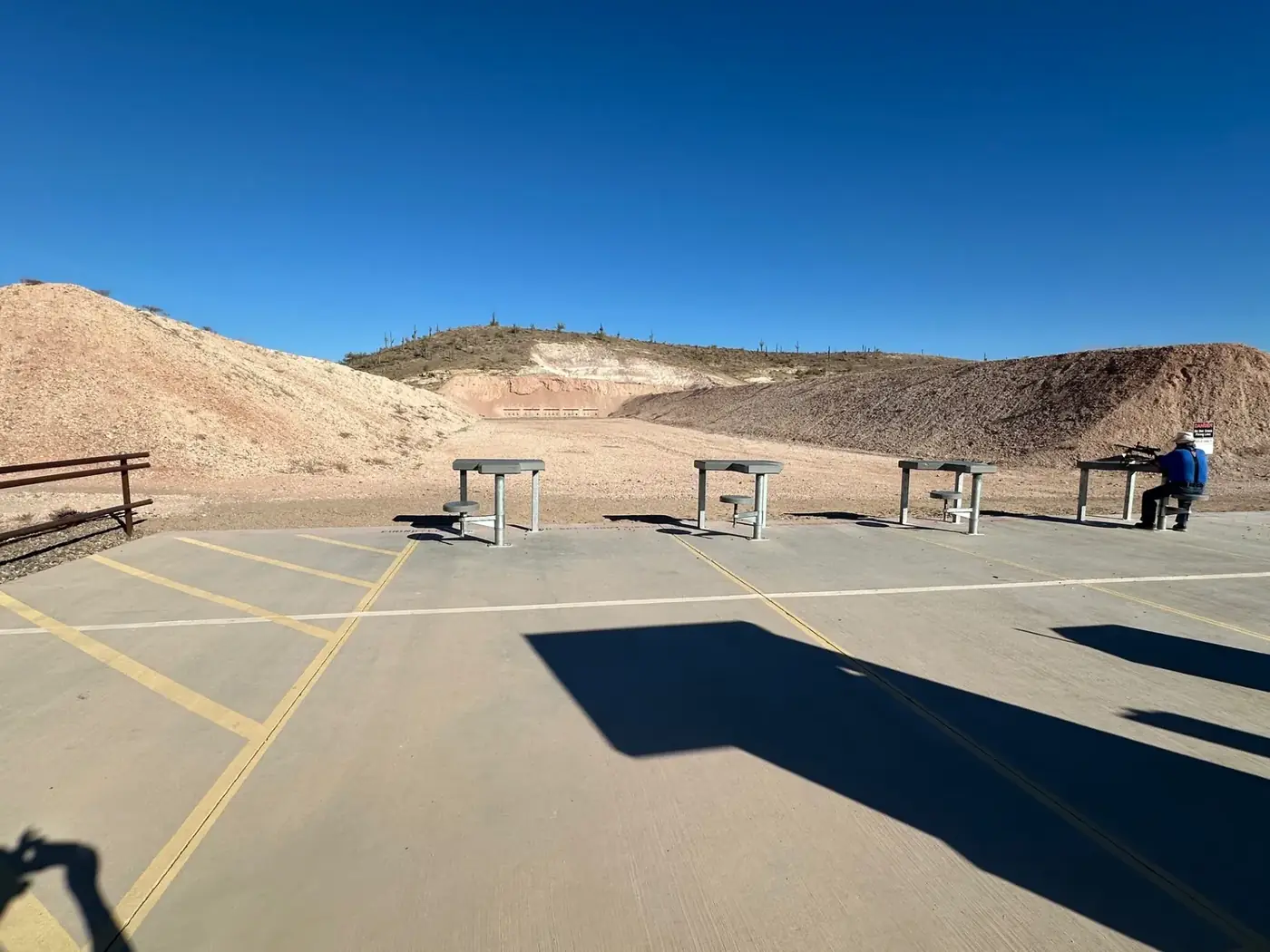
The fastest way to find a free or low-cost public shooting range is to start with your state wildlife agency, which runs many public ranges, then check a directory that lists public access. We list 764 public ranges across the country, 51 of which are listed as free, and 412 ranges that offer day passes for non-members. Browse public ranges or free ranges by state, then confirm hours, fees and any permit requirements on the operating agency's page before you go. "Free" does not always mean no paperwork: some states require a hunting or fishing license, a range permit or a conservation pass to use their ranges.
Key points
- State wildlife and natural resources agencies run more public ranges than any other operator.
- Many state ranges were built or improved with Pittman-Robertson funds from federal excise taxes on firearms, ammunition and archery equipment.
- "Free" can still mean a license, permit, conservation pass, sign-in or posted hours.
- Unstaffed public ranges usually have nothing to rent or buy, so bring everything you need and pack it all out.
Who runs public ranges
"Public" here means open to the general public without a club membership. Public ranges are run by a mix of operators:
- State wildlife and natural resources agencies. These are the largest group. Many wildlife management areas have rifle, pistol, shotgun or archery ranges, from a simple berm and benches to staffed facilities with covered firing lines.
- Counties and cities. Some parks departments and sheriff's offices operate public ranges, often with a small fee.
- Federal land managers. The Bureau of Land Management and the US Forest Service manage some designated shooting sites, and much of their land is open to dispersed target shooting under their rules. We list 62 BLM-sourced and 36 Forest Service-sourced locations.
- Private businesses and clubs with public hours. These are not government-run, but many sell day passes or hold public days.
State wildlife and natural resources agency records are the source of 1,658 of our listings, which shows how central those agencies are to range information in most states.
Why so many state ranges exist
Many public ranges were built or improved with federal Wildlife and Sport Fish Restoration funds, often called Pittman-Robertson funds after the 1937 law that created the wildlife program. The money comes from federal excise taxes on firearms, ammunition and archery equipment, and it is distributed to state fish and wildlife agencies for wildlife conservation, hunter education and public target ranges. The US Fish and Wildlife Service administers the program, and you can read about it at fws.gov.
In practice, that means shooters and hunters help pay for these ranges every time they buy gear, and it is one reason state ranges are often free or inexpensive to use.
Free vs day pass vs members-only
| Access type | What it usually means | What to check |
|---|---|---|
| Free | No fee to shoot | Whether a license, permit or pass is still required, and opening hours |
| Day pass | Pay per visit, no membership | Fee, lane limits, whether you need a reservation or a safety briefing |
| Members-only | Club membership required | Guest policy, waitlist, initiation and dues (see how to choose a gun club) |
If there is no free range nearby, a day pass range is the next best option. Our guide to how much a shooting range costs covers typical fee structures.
What "free" can still require
Rules vary by state and by range, so always read the agency's page for the specific range. Common requirements include:
- A license or pass. Some states require a current hunting or fishing license, a range permit, or a conservation or habitat stamp to use wildlife area ranges, even if there is no separate range fee.
- Sign-in. Many ranges have a sign-in sheet or kiosk.
- A safety briefing or orientation at staffed ranges, especially for first-time visitors.
- Age rules. Minors often need an adult with them.
- Range hours and closures. Many public ranges close on certain days, for maintenance, for hunting seasons on the surrounding land, or during fire restrictions.
Tip: The operating agency's page for the specific range is the source to trust for current fees, hours, closures and permit requirements. Check it the day you plan to go.
Typical rules at public ranges
Unstaffed public ranges rely on shooters to run themselves safely. Expect posted rules like these, and read the sign at the entrance every time:
- Cease-fire procedures: everyone unloads, steps back from the line, and nobody goes downrange until all firearms are unloaded and benched. Our guide to range rules and etiquette explains range commands.
- Paper or cardboard targets only on many rifle and pistol ranges, posted on the range's own frames. Bring a target stapler and paper targets.
- No glass, cans, appliances or other trash as targets.
- No exploding targets and, on many ranges, no tracers or incendiary ammunition.
- Restrictions on calibers, rapid fire, or shooting from positions other than the bench.
- Pack out all targets, brass and trash.
- Eye and ear protection required.
And the standard safety rules apply everywhere: treat every firearm as loaded, keep the muzzle pointed in a safe direction, keep your finger off the trigger until you are ready to fire, and know your target and what is beyond it.
How to find public ranges near you
- Search our directory. Start with public ranges and filter by state, for example public ranges in Utah, Texas or Pennsylvania. The free ranges page lists the 51 we have marked as free, including state pages such as free ranges in Missouri. You can also use ranges near you.
- Check your state wildlife agency. Most publish a list or map of their ranges with hours, rules and any permit requirements. This is the source to trust for current fees and rules.
- Check federal land managers. BLM field offices and Forest Service ranger districts can point you to designated shooting areas. Read our guides to target shooting on BLM land and target shooting in national forests.
- Look at clubs with public days. Some gun clubs open to the public on certain days or for events.
What to bring
Public ranges, especially unstaffed ones, usually have nothing to rent or buy on site. Bring everything you need:
- Eye and ear protection. Electronic earmuffs let you hear range commands and conversation, and shooting glasses are essential. See our guides to hearing protection and eye protection.
- Targets, a stapler or tape, and a target stand if the range does not provide frames.
- A shooting rest or bags for bench work.
- Water, sun protection and a first aid kit.
- Trash bags and something to collect brass.
- Any license or permit the state requires, plus ID.
A range bag keeps it all together; our range bag checklist has a full list. If this is your first trip, read first time at a shooting range too.
Keeping public ranges open
Public ranges stay open when users take care of them. A few habits help:
- Clean up after yourself and pick up after others when you can.
- Report damage, unsafe behavior or vandalism to the managing agency.
- Respect hours and closures, including hunting season closures.
- Be welcoming to new shooters. A short, friendly explanation of the range rules helps more than a lecture.
Wrap-up
Most free and public ranges are run by state wildlife agencies, many with help from Pittman-Robertson funds, and plenty more are run by counties, cities and federal land managers. Use our public ranges and free ranges pages to find candidates near you, then confirm fees, hours and any license or permit requirement on the agency's page. If you know a public range that is not in the directory, please add it.