
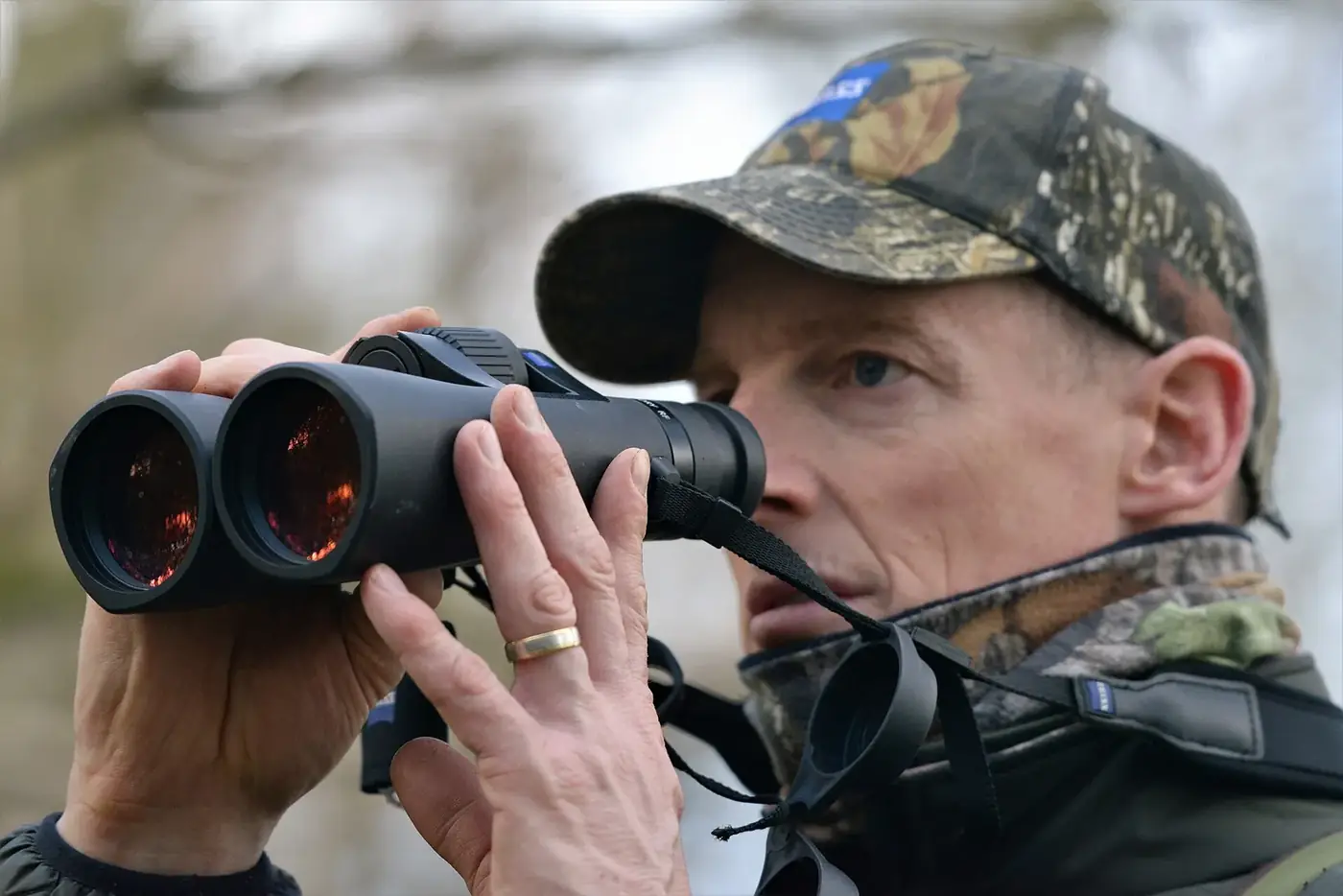
For most hunting, an 8x42 or 10x42 binocular is the right starting point: 8x gives a wider, steadier view for timber and close cover, and 10x shows more detail across open country. For a rangefinder, look for a clear display, a yards setting, and angle compensation if you hunt steep ground or shoot a bow. The rest of this guide explains what the numbers on the box mean so you can compare models on your own terms.
Key points
- An 8x42 or 10x42 binocular is the right starting point for most hunting.
- 8x gives a wider, steadier view for timber; 10x shows more detail across open country.
- Exit pupil (objective size divided by magnification) is a guide to low-light brightness, not the full story.
- In a rangefinder, look for a clear display, a yards setting, and angle compensation for steep ground or bowhunting.
Reading binocular numbers
Every binocular is labeled with two numbers, such as 8x42.
- The first number is magnification. An 8x binocular makes things look eight times closer than they do to the naked eye.
- The second number is the objective lens diameter in millimeters, the size of the front lenses. Bigger objectives gather more light but add weight and bulk.
8x42 vs 10x42
Both are popular for good reasons. The tradeoffs:
| 8x42 | 10x42 | |
|---|---|---|
| Image detail | Less | More |
| Field of view | Wider, easier to find moving game | Narrower |
| Steadiness | Easier to hold steady | Shows more hand shake |
| Exit pupil | 5.25 mm | 4.2 mm |
| Best fit | Woods, brush, close and moving game | Open country, glassing at distance |
Higher magnifications like 12x or 15x are used for long-range glassing in open country, usually on a tripod. Compact sizes like 8x32 or 10x32 save weight for hunters who walk a lot, at the cost of some low-light performance.
Exit pupil
Exit pupil is the size of the beam of light that leaves the eyepiece. Divide the objective size by the magnification:
- 8x42: 42 ÷ 8 = 5.25 mm
- 10x42: 42 ÷ 10 = 4.2 mm
- 10x32: 32 ÷ 10 = 3.2 mm
In bright daylight, your own pupils shrink to a few millimeters, so any of these looks bright. At dawn and dusk, when many animals move, your pupils open wider, and a larger exit pupil can deliver a brighter image. The human pupil's maximum opening tends to shrink with age, so the low-light advantage of a very large exit pupil is smaller for some hunters than for others. Glass quality and lens coatings also affect brightness, so exit pupil is a guide, not the full story.
Field of view
Field of view is how wide an area you see, usually listed as feet at 1,000 yards or as an angle in degrees. A wider field makes it easier to find a deer that steps out of cover or follow a bird in flight. For the same objective size, higher magnification generally means a narrower field.
Eye relief
Eye relief is how far from the eyepiece your eye can be and still see the full image. If you wear glasses, look for longer eye relief and eyecups that twist down, or you will see a smaller circle with dark edges.
Waterproof and fogproof
Hunting binoculars get rained on, dropped in snow and carried from a warm truck into cold air. Look for models listed as waterproof (sealed with O-rings) and fogproof (filled with nitrogen or argon gas so moisture cannot condense on internal lenses). The outside lenses can still fog from your breath or a temperature change, so keep a lens cleaning kit or cloth in your pack.
Roof vs porro prism
Roof prism binoculars have straight barrels and are compact and easy to seal. Porro prism binoculars have the offset, zigzag shape. Both can deliver good images; most current hunting binoculars are roof prism designs.
Carrying and using binoculars
A binocular that stays in the pack does not get used. A chest harness keeps it protected, quiet and ready, and spreads the weight off your neck. For long glassing sessions, a tripod adapter and a light tripod let you hold even 10x or higher magnifications steady.
Safety: Use binoculars, not your rifle scope, to look at things you have not identified. Scanning with a scope means pointing a firearm at whatever you are looking at, including other people.
Rangefinders
A laser rangefinder sends out a pulse of light, measures how long it takes to bounce back, and shows the distance. For hunters, it answers two questions: is this animal within my effective range, and how much holdover or sight pin do I need?
The features below are covered in detail in this section:
| Feature | Why it matters |
|---|---|
| Yards or meters setting | Must match your scope data or bow sight pins |
| Angle compensation | Corrects distance on steep uphill or downhill shots |
| Range on game | Real range on animals is well short of the reflective-target maximum |
| Target modes | Pick the right reading when brush or a hillside is also in the beam |
| Readable display | Must show clearly against bright sky and dark timber |
Yards vs meters
Most rangefinders can display either yards or meters. Make sure yours matches your scope's ballistic data or your bow sight's pins. Mixing them is a simple way to miss, because a meter is about 10 percent longer than a yard.
Angle compensation
When you shoot steeply uphill or downhill, gravity acts on the projectile over the horizontal distance, not the straight-line distance to the target. On steep angles the straight-line distance overstates how much drop you need to account for. Rangefinders with angle compensation measure the incline and show a corrected distance (manufacturers use different names for this feature). It matters most for bowhunters, since arrows drop much more than bullets, and for rifle hunters shooting at long distance in mountains. Check the manual for how your model labels the corrected and line-of-sight readings.
Reflectivity and maximum range
The maximum range on the box is usually measured on a highly reflective target. Animals, especially with dark or dull coats, reflect less light, so the real distance at which you can range a deer is usually well short of the advertised maximum. Fog, rain, snow, bright sun behind the target and a shaky hand all reduce performance. Manufacturers often list separate figures for reflective targets, trees and game; compare those, not just the largest number.
Target modes
Many rangefinders offer modes that decide which return to show when the beam hits more than one thing:
- First target mode shows the closest object, useful when ranging an animal in front of a hillside.
- Last target or distant mode ignores brush and branches in front of the target.
Display and size
Look for a display you can read against both bright sky and dark timber. Some rangefinders use red displays, others black; preference varies. Most hunting rangefinders are compact enough for a pocket or harness pouch. Some binoculars include a built-in rangefinder, which saves carrying two devices but costs more and weighs more.
Brands to start your search
Several optics makers are well established in hunting and sell both binoculars and rangefinders. Compare current models and their published specs directly:
Before buying, check the warranty terms, which differ a lot between brands, and try optics in person at a local gun shop or outdoor retailer if you can.
Practice with your optics before the season
A rangefinder is only useful if you trust it and know your own effective range. Range known targets at a shooting range, then compare your readings to the posted distances. Rifle hunters can confirm holdovers at a long-range facility or any rifle range with distances past 100 yards. Bowhunters can practice judging and ranging distances on a 3D course; see our archery ranges guide.
Find a range
Start with ranges near you or browse ranges by type. For the rest of your pack, the hunting gear checklist covers everything else. If you know a range that is not listed, add it to the directory.