
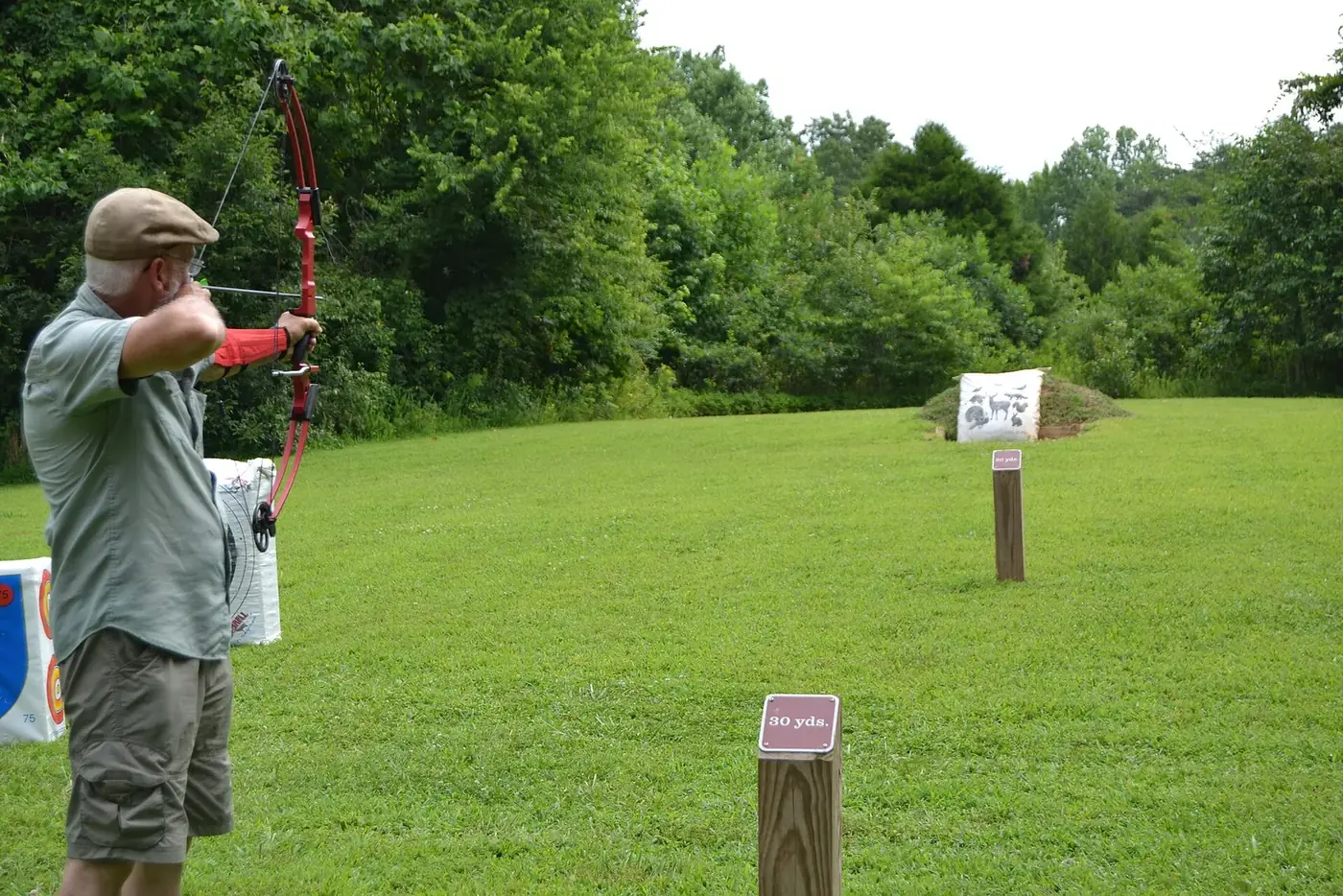
An archery range is a place set up for shooting arrows safely: a marked shooting line, targets at known distances, and a backstop or open area behind them. Most fall into four types (static target lanes, 3D courses, field courses and indoor lanes), and nearly all run on the same basic etiquette: everyone shoots from the line together, nobody walks forward until the range is called clear, and you never release a drawn bow without an arrow on the string. This guide covers what you will find, how a session runs, and what gear to bring.
We list 773 ranges with archery facilities, from public lanes on state wildlife land to private clubs and indoor shops.
Key points
- Most archery ranges are static target lanes, 3D courses, field courses or indoor lanes.
- Everyone shoots from the line together, and nobody walks forward until the range is called clear.
- Never dry fire a bow: releasing it without an arrow can damage the bow and injure people nearby.
- Indoor shop ranges are the easiest first stop, with staff, rentals and controlled lines.
Types of archery ranges
Here is a quick comparison before the details:
| Type | Best for | Notes |
|---|---|---|
| Static target lanes | Beginners, form and grouping practice | Fixed, marked distances; many public lanes are unstaffed |
| 3D courses | Bowhunters | Walking trail, life-size foam animals, often unmarked distances |
| Field courses | Varied-distance target practice | Walking course with paper faces, slope and lighting challenges |
| Indoor lanes | First visits, winter practice | Short lanes, year-round, often attached to a shop with rentals |
Static target lanes
The most common setup. A straight shooting line faces a row of targets at fixed distances, often marked in yards or meters. Targets are usually bag or foam blocks, or paper faces on foam butts. This is where most people start and where target archers practice form and grouping. Many public lanes are outdoor, unstaffed, and run on posted rules.
3D courses
A 3D course is a trail through woods or fields with life-size foam animal targets placed at different distances and angles. You walk from stake to stake and shoot at each animal, often at unmarked distances so you have to judge range yourself. Bowhunters use these to practice realistic shots: uphill, downhill, through gaps in brush. Some courses have stakes of different colors for different skill levels or equipment.
Field courses
Field archery is also a walking course, but with paper target faces instead of animal targets. Distances vary from short to long across the course, and the terrain adds slope and lighting challenges. Field rounds follow formats set by archery organizations, but many clubs also have informal field courses.
Indoor lanes
Indoor ranges have short, marked lanes (often 20 yards or 18 meters) and run year-round regardless of weather. Many are attached to archery shops, which makes them a good first stop: staff can check your draw length, help you pick equipment, and often rent bows. Indoor ranges also run leagues in the winter. See our indoor listings and filter for archery.
How a session runs: commands and etiquette
Ranges with more than a few archers use a controlled shooting line. Many follow a whistle system like this one, which is widely used in organized archery:
- Two whistle blasts: archers move up to the shooting line.
- One blast: begin shooting.
- Three blasts: shooting is over, walk forward to retrieve arrows.
- Five or more blasts: stop shooting immediately. Let down your bow and take any arrow off the string.
Unstaffed ranges usually use verbal calls instead. Someone says "clear?" and waits for everyone to finish and agree, then calls "range is clear" before anyone walks forward. Whatever the system, these rules apply nearly everywhere:
- Only nock an arrow when you are on the line and shooting has started. Never nock an arrow while someone is forward of the line.
- Point arrows only downrange, and draw only toward the target, never with the bow raised high above it.
- Never dry fire. Releasing a drawn bow without an arrow sends all the stored energy into the bow itself. It can crack limbs, derail a cam or string, and injure you or people near you. Many shops will not repair a bow that has been dry fired, and some manufacturers' warranties exclude it.
- Walk, do not run, to the targets. Arrows on the ground and fletchings sticking out of the grass are easy to step on.
- Stand to the side when pulling arrows, and check behind you first. An arrow nock to the face is a real risk when someone pulls hard from directly behind.
- Look for missed arrows behind the target before calling the range clear again. If you cannot find one, many ranges ask you to look after the next end rather than holding up everyone.
- Use field points unless the range says otherwise. Broadheads tear up foam targets, and many ranges only allow them at a dedicated broadhead target or pit.
- Ask about crossbows. Some ranges welcome them, some limit them to specific lanes, and some do not allow them at all.
Tip: If you are new, tell the range officer or staff when you arrive. Most are happy to walk you through the local rules.
The same goes for posted rules on unstaffed lanes: read them before you nock an arrow. Our general guide to range rules and etiquette covers what firearm ranges expect, and many of the same courtesies carry over.
Gear you need
A bow and arrows are the core, and arrows need to match your bow's draw weight and your draw length. A local archery shop is the best place to get both fitted. Beyond that, these accessories cover most of what you will use on a range:
Protection
- Arm guard. A bracer on the inside of your bow arm stops the string from slapping your forearm. Arm guards are inexpensive and especially useful for beginners.
- Finger tab or shooting glove. For recurve, longbow and traditional shooters who draw with their fingers. Finger tabs give a cleaner release; shooting gloves are common with traditional bows.
- Chest guard for anyone whose string catches loose clothing.
Release and accessories
- Release aid. Most compound archers use a mechanical release aid, either a wrist-strap index-finger style or a handheld style. Learn to use it from a coach or the shop before shooting on a busy line.
- Arrow puller. A rubber arrow puller gives you grip on arrows stuck deep in foam and saves wear on your shafts and hands.
- Quiver. A hip, back or bow-mounted quiver keeps arrows off the ground.
- Bow stringer. Recurve and longbow shooters need a bow stringer to string and unstring safely.
Targets and transport
- Practice target. If you shoot at home where it is legal and safe, a bag target for field points or a 3D foam target lets you practice between range trips.
- Bow case. A bow case, soft or hard, protects sights and rests in the car and makes transport simple.
Also bring water, sun protection for outdoor lanes, and something to write scores on if you are shooting a course.
Choosing a range for your first visit
- Indoor shop ranges are the easiest start: staffed, often with rentals and lessons, and controlled lines.
- Public outdoor lanes, many managed by state wildlife agencies, are often free or cheap to use but may be unstaffed. Read posted rules and check whether a permit or license is required. Our guide to free and public ranges explains how to find them.
- Club 3D courses are great once you can group arrows consistently, especially if you bowhunt.
Many listings note whether they offer lessons or a day pass, which helps if you do not want to join a club before you know the sport.
Find an archery range
Browse all archery ranges or narrow by state, for example archery ranges in Texas, or start from ranges near you. Call ahead to confirm hours, crossbow and broadhead rules, and whether you need to bring your own targets. If you know a range we are missing, please add it to the directory.