
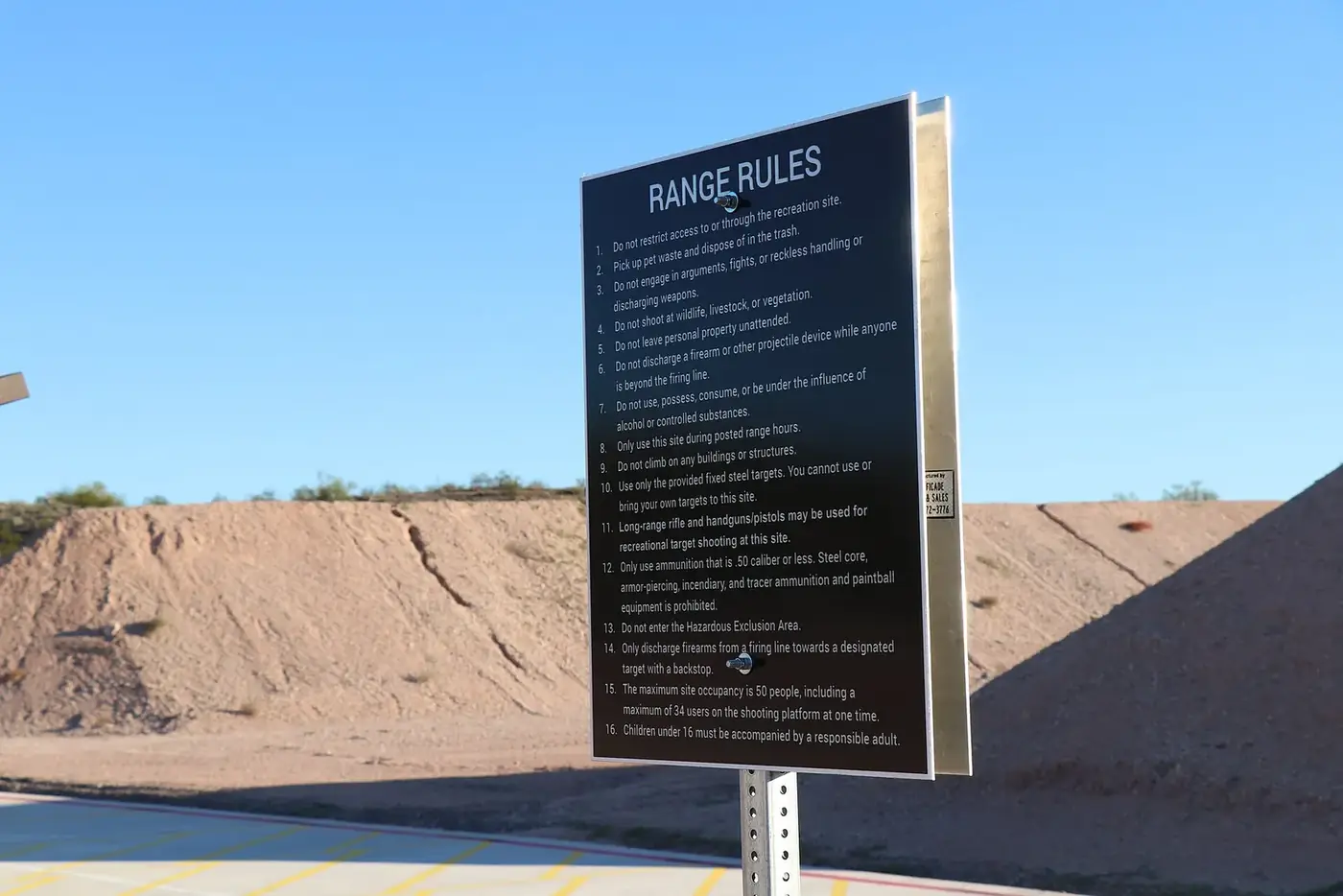
Shooting range rules come down to three things: the four universal firearm safety rules, the range commands that control when people can shoot and when they can walk downrange, and the posted rules specific to each range. Learn the core rules and the commands "cease fire," "the line is hot," and "the line is cold," follow the range officer's instructions without argument, and you will fit in at almost any range in the country. Etiquette fills in the rest: clean up your lane, respect other shooters' space, and ask before you touch anything that is not yours.
Key points
- Range rules come down to the four universal safety rules, the range commands and each range's posted rules.
- Anyone can call "cease fire," and when you hear it, stop shooting instantly.
- Never handle a firearm while the range is cold, even to case or clean it.
- Etiquette covers the rest: stay in your lane, give people space and clean up when you leave.
The four universal safety rules
Every range, club and instructor teaches these. They overlap on purpose, so that breaking one rule does not by itself lead to an injury.
- Treat every firearm as if it is loaded. Checking a gun does not make it safe to handle carelessly.
- Never let the muzzle cover anything you are not willing to destroy. On the range, the muzzle stays pointed downrange, including while loading, unloading and clearing malfunctions.
- Keep your finger off the trigger until your sights are on the target and you have decided to fire. Rest your finger straight along the frame.
- Be sure of your target and what is beyond it. Shoot only at your own target, and only where the backstop or berm will stop the round.
Range commands and what they mean
Wording varies from range to range, and some ranges use whistles, horns or lights in addition to voice commands. These are the most common ones.
| Command | What it means | What you do |
|---|---|---|
| Cease fire | Stop shooting now. | Stop immediately, finger off the trigger, muzzle downrange. Wait for instructions. |
| The line is hot / Range is hot | Shooting is permitted. | You may load and fire at your target. No one goes forward of the line. |
| The line is cold / Range is cold | No shooting. People may go downrange. | Unload, open the action, set the firearm down, step back from the line. Do not touch firearms. |
| Make safe / Unload and show clear | Prepare for a cold range. | Remove magazine, empty the chamber, lock the action open, set it down. |
| Commence fire | Begin shooting. | Fire at your target. |
Cease fire: anyone can call it
"Cease fire" is the most important command on any range, and anyone can call it, not only the range officer. If you see something unsafe (a person downrange, an animal on the range, a muzzle pointed the wrong way), call "cease fire" loudly and clearly. When you hear it, stop shooting instantly, even mid-string. Do not finish the round in the chamber. Keep the muzzle downrange, take your finger off the trigger, and wait.
Going downrange during a cold range
On outdoor ranges, shooters walk downrange together to change targets. Before anyone goes forward:
- Every firearm on the line is unloaded with the action open, magazines removed.
- Firearms are set on the bench or in a rack, pointed downrange or upward as the range specifies.
- Everyone steps back behind a marked line, often called the safety line or ready line.
Do not handle any firearm while the range is cold, even to put it in a case or clean it. Wait until everyone is back and the RO declares the line hot. This is one of the most strictly enforced rules at public ranges.
Tip: Wording varies, so if you are unsure what a command means at a new range, ask the range officer before you start shooting.
Posted rules vary, so read them
Each range adds rules on top of the universal ones, and they are worth reading every time you visit a new place. Common examples:
- Rate of fire limits. Some ranges ban rapid fire or limit you to one shot per second.
- Ammunition restrictions. Steel-core, tracer, incendiary and armor-piercing rounds are commonly banned because they cause fires or damage target backstops. Some indoor ranges require you to buy ammunition on site.
- Drawing from a holster. Many ranges prohibit holster draws unless you have passed a range-specific qualification.
- Target placement. Targets must usually be placed so that rounds hit the berm, not the ground in front or the top of the backstop.
- Steel targets. Ranges that allow steel usually set minimum distances and ban certain calibers. Browse ranges with steel targets if that matters to you, and see our targets guide.
- Firearm types. Some pistol bays do not allow rifles, and some rifle ranges do not allow handguns.
Public ranges run by state wildlife agencies often post rules at the entrance and on the agency website. We list 764 public ranges; you can browse them on our public ranges page and check each one's operator for current rules. Rules on public land outside developed ranges are set by the land manager. See our guides to shooting on BLM land and shooting in national forests.
Range etiquette
Etiquette is the part no one writes on the sign, but regulars notice.
On the firing line
- Stay in your lane. Shoot only at your own target. Shooting at a neighbor's target or across lanes is a safety issue, not just bad manners.
- Give people space. If the range is nearly empty, do not set up in the lane right next to someone.
- Do not handle someone else's firearm without permission, and when you hand a firearm to someone, unload it, lock the action open and hand it over with the muzzle pointed safely.
- Do not coach strangers unless they ask. If you see something unsafe, tell the RO.
- Keep the line clear. Put your bag and case behind you or under the bench, not in the walkway.
Brass and cleanup
- Ask about brass. Some ranges let you collect your own spent brass; others keep everything that hits the floor. Do not pick up brass from other lanes without asking.
- Clean your lane when you leave. Pick up targets, staples, boxes and trash.
- Take down your target stand if the range does not supply permanent ones.
Courtesy
- Listen to the RO. If you are corrected, say "okay" and fix it. Arguments on the firing line slow everyone down and can create real danger.
- Keep conversation and phone calls off the line.
- Respect time limits at busy ranges where lanes are booked by the hour.
- Bring your own protective gear if possible. Foam ear plugs and shooting safety glasses are cheap enough to keep a spare set in your bag for a friend.
Rules for bringing a new shooter
If you bring a friend, a family member or a child, you are responsible for them. Brief them on the four rules and the commands before you arrive, stay next to them on the line, and start with a low-recoil firearm at a close target. Make sure they have properly fitting protection: youth-size earmuffs for kids, and electronic earmuffs if you want to talk quietly while still blocking gunshot noise. Many ranges require one supervising adult per minor on the line. A first lesson at a range that offers instruction is often the best start. Our first-time visitor guide covers check-in and what to bring.
Gear that helps you follow the rules
- A chamber flag, which shows at a glance that a firearm's chamber is empty. Many ranges require them during cold periods.
- A range bag with dividers keeps magazines, ammunition and tools organized so you are not fumbling on the line. See our range bag checklist.
- A brass catcher or brass pickup tool, if the range lets you keep your brass.
Wrap-up
Learn the four safety rules, know what "cease fire," "hot" and "cold" mean, and read the posted rules every time you visit a new range. Everything else is common courtesy. When you are ready to put it into practice, find a range near you, look for a local gun club, or browse ranges by state. Know a range we are missing? Add it to the directory.