
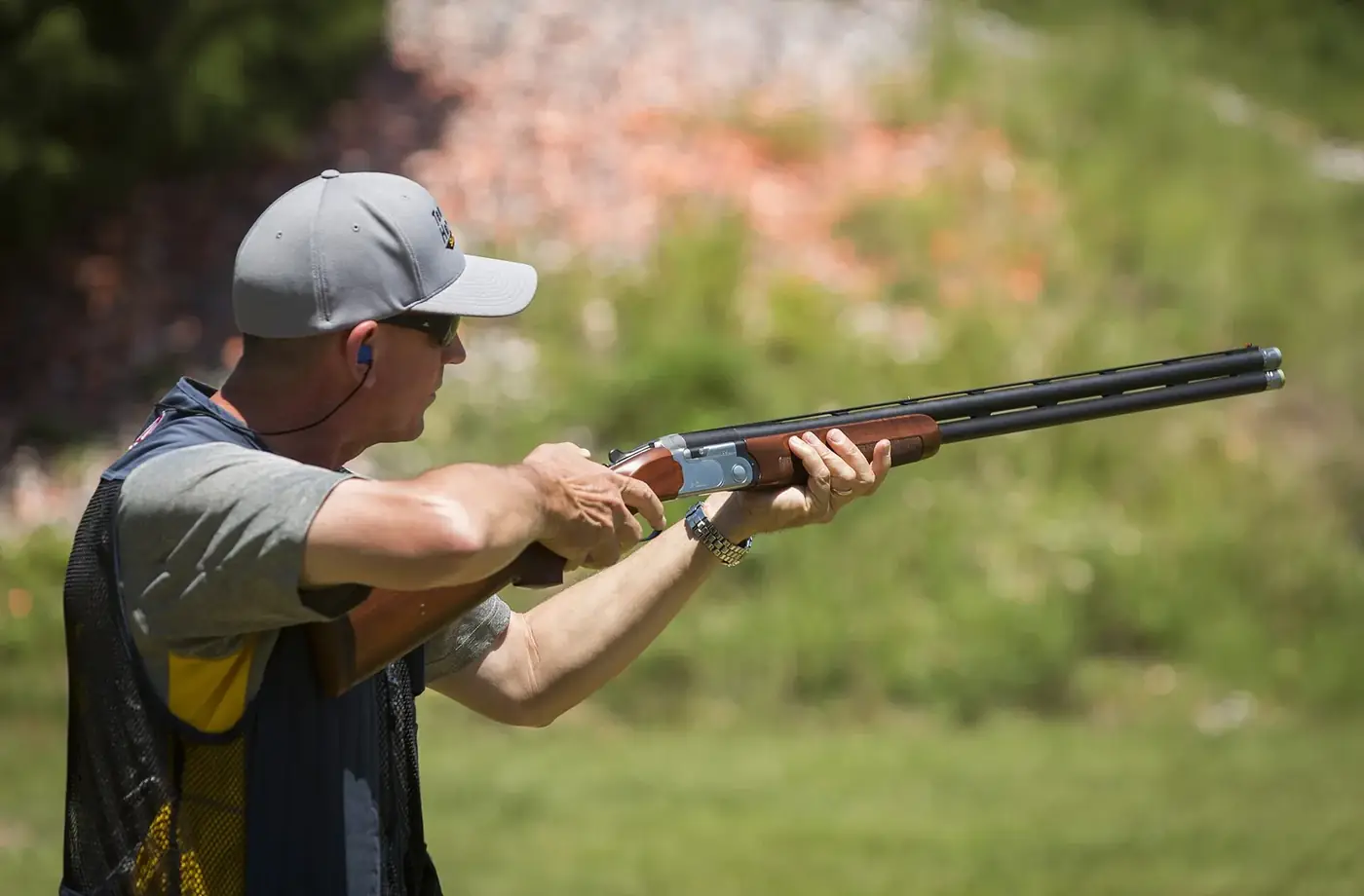
Trap, skeet and sporting clays are all shotgun games where you break clay targets in flight, but the field layout and the targets are different. In trap, targets fly away from you out of a single house in front of the line. In skeet, targets cross in front of you from two houses on fixed paths. Sporting clays is a walking course of stations that mimic the flight of game birds and rabbits, with targets that change from station to station. This guide covers how each game works, how a round runs, and what to bring for your first visit.
Key points
- In trap, targets fly away from you out of one house, at angles you do not know in advance.
- In skeet, targets cross in front of you from a high house and a low house on fixed paths.
- Sporting clays is a walking course of stations that mimic game birds and rabbits; five-stand is a compact version.
- A 12-gauge or 20-gauge shotgun covers all three games, and eye and ear protection are required on the field.
The quick comparison
| American trap | Skeet | Sporting clays | |
|---|---|---|---|
| Target source | One trap house in front of the shooters | High house and low house at either end of a semicircle | Multiple traps placed around a course |
| Shooting positions | Five stations, 16 yards behind the house (more for handicap) | Eight stations | Typically 10 or more stations on a walking course |
| Target paths | Going away, at an angle you do not know in advance | Fixed, the same every time | Varies by station and by course |
| Feel | Rhythm and consistency | Learnable angles, crossing shots | Variety, closest to field hunting |
We list 526 ranges with trap, 358 with skeet and 237 with sporting clays, and many clubs offer more than one.
American trap
A trap field has a single low building, the trap house, sitting in front of five shooting stations. In standard singles, the stations are on a line 16 yards behind the house, spread in a shallow arc. A squad of up to five shooters takes one station each.
The machine inside the house oscillates, so each target leaves at an angle within a set range to the left or right. You know roughly where it comes from, but not which way it will go. Shooters call "pull" (or any consistent call) and the target is released, often by voice-activated equipment or a puller.
A standard round is 25 targets. Each shooter fires five shots at their station, one shooter at a time in rotation down the line, then everyone moves one station to the right. The shooter at station 5 walks behind the squad to station 1. Move with your action open and your gun unloaded.
Two variations you will hear about:
- Handicap trap: shooters stand farther back than 16 yards, with the distance assigned based on past scores.
- Doubles trap: two targets leave the house at once on fixed angles, and you shoot both.
Trap rewards a repeatable setup: same stance, same gun mount, same hold point, every shot. Many trap shooters use guns with a tighter choke because the targets are moving away and the shots are longer than in skeet.
Skeet
A skeet field is a semicircle with a building at each end. The high house stands on the left side as you face the field and releases targets from a window several feet up. The low house is on the right and releases targets from near ground level. Both machines throw targets on the same fixed path every time, crossing near a center point in front of the field.
There are eight stations. Stations 1 through 7 run around the semicircle from the high house to the low house, and station 8 sits in the middle, between the two houses. Because the target paths never change, each station gives you a different, but predictable, angle: going away, incoming, and straight crossing shots.
A standard round is 25 targets. The general pattern is singles from both houses at every station, with doubles (one target from each house at the same time) at some stations. Station 8 produces very close, fast shots. The 25th shot is often called the option, and it is commonly taken by repeating the first target you missed. Rule details are set by the sanctioning body, and clubs usually post them or walk new shooters through the sequence.
Skeet is often the easiest game for learning crossing shots and lead, because you can shoot the same target again until you understand it. Open chokes are common since most shots are close.
Sporting clays
Sporting clays is often called golf with a shotgun. Instead of one field, you walk (or ride a cart) around a course of stations set in woods, fields and along water. At each station, traps throw a set of targets meant to simulate game: a flushing bird, a crossing dove, a duck dropping into decoys, a rabbit target that bounces along the ground.
What makes sporting clays different:
- Every station is different, and courses are often reset, so you cannot memorize a single set of angles.
- Target sizes vary. Besides standard clays, you may see smaller and faster minis, midis, flat battue targets that turn in the air, and thick rabbit targets that roll.
- Presentations come as pairs, either simultaneous (both at once), report (second target launches at the sound of your first shot) or following (second target released shortly after the first).
- Shots range from very close to long, so you think about each presentation before you shoot.
| Pair type | How the second target launches |
|---|---|
| Simultaneous | At the same time as the first |
| Report | At the sound of your first shot |
| Following | Shortly after the first |
Tip: Many clubs let you watch a station's targets once before you shoot it. Use that look to plan where you will break each one.
Many clubs let you watch the targets once before shooting a station, and a round is commonly scored out of 50 or 100 targets. Because the setting is spread out, keep your gun unloaded with the action open between stations, and load only when you are in the station cage and it is your turn.
Five-stand
Five-stand is a compact version of sporting clays. Five shooting stations sit side by side in a line, with several traps placed around the field. Each station has a menu card that tells you which traps will release, in what order, and whether you get singles or pairs. Shooters rotate through all five stations. It gives you sporting-style variety without walking a full course, and many clubs that have trap or skeet fields offer it as well.
Which one should you try first?
- Choose trap if you want a simple, repeatable game and like building consistency.
- Choose skeet if you want to learn how to lead crossing targets, with angles that stay the same.
- Choose sporting clays or five-stand if you hunt upland birds or waterfowl, or want variety more than repetition.
Most clubs welcome new shooters, and many have instructors or experienced members who will coach a first round. Look at ranges that offer lessons and ranges with rentals if you do not own a shotgun yet. Our guide to choosing a gun club covers membership versus paying per round.
Safety on a clay field
The standard safety rules apply everywhere: treat every firearm as loaded, keep the muzzle pointed in a safe direction, keep your finger off the trigger until you are ready to shoot, and know your target and what is beyond it. Clay sports add a few habits of their own:
- Carry a break-action gun open and empty when you are not on the station. Semi-autos and pumps should have the action open, and many clubs use a chamber flag.
- Load only when it is your turn and you are on the station.
- Never swing your gun past the safe zone of fire to chase a target, and never shoot at a target that has gone outside your field.
- If a gun fails to fire, keep it pointed downrange and wait before opening it.
- Wear eye and ear protection at all times on the field. See our guides to hearing protection and shooting glasses.
Gear for clay shooting
A 12-gauge or 20-gauge shotgun covers all three games, and ranges usually require target loads with small shot. Amazon does not sell shotguns or shells, so pick those up at a gun shop or the club. The rest of the kit:
- Shooting glasses, ideally with interchangeable lenses for bright and overcast days
- Electronic earmuffs or foam earplugs
- A shooting vest with shell pockets and a recoil pad area
- A shell pouch if you prefer a belt setup
- A choke tube wrench if your gun takes interchangeable chokes
- A shotgun case for getting to and from the club
- A hand-held clay thrower and clay targets for practice where it is legal and safe
Find a clay range
Start with our lists of trap ranges, skeet ranges and sporting clays courses, or browse gun clubs near you. Call ahead to confirm hours, whether non-members can shoot, and what loads are allowed. If your local club is missing from our directory, you can add it here.